
VIP member
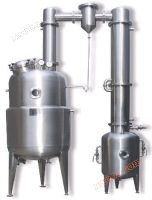
Product details
1、 Purpose and Characteristics
This equipment is suitable for heat transfer, evaporation, and concentration of viscous materials, and has the characteristics of high evaporation capacity and high concentration viscosity. Widely used for vacuum concentration of liquid materials in traditional Chinese medicine, western medicine, food, glucose, fruit juice, candy, biopharmaceuticals, chemical industry, etc.
2、 The vacuum decompression concentration tank uses vacuum evaporation to lower the boiling point of the solution. Vacuum evaporation has the following advantages:
2.1 As the boiling point of a solution depends on the operating pressure, when the boiling point of the solution under reduced pressure is lower than that under normal pressure and the pressure of the heating vapor is constant, vacuum evaporation can be used to lower the boiling point of the solution, thereby increasing the effective temperature difference for heat transfer and increasing the driving force. The heat transfer area of a certain heat flow evaporator can be reduced, which enhances the evaporation operation.
2.2 The requirements for heating sources can be reduced, providing the possibility of using low-pressure steam or waste heat steam as a heat source.
2.3 Due to the operating pressure being lower than atmospheric pressure, the decrease in boiling point of the solution can reduce or prevent the decomposition of heat sensitive materials. It can concentrate solutions that are not resistant to high temperatures and is suitable for treating heat sensitive solutions.
2.4 By lowering the boiling point of the solution, the heat loss of the evaporator can be reduced.
3、 Structure of vacuum depressurization and concentration tank:
The vacuum depressurization concentration tank mainly consists of six components: concentration tank, first condenser, gas-liquid separator, second condenser, cooler, and liquid receiving tank, all of which are made of stainless steel. The concentration tank is a jacketed structure, the condenser is a tubular type, and the cooler is a serpentine type.
The vacuum depressurization concentration tank mainly consists of six components: concentration tank, first condenser, gas-liquid separator, second condenser, cooler, and liquid receiving tank, all of which are made of stainless steel. The concentration tank is a jacketed structure, the condenser is a tubular type, and the cooler is a serpentine type.
4、 Structure and Performance of Vacuum Decompression Concentrator
The vacuum depressurization concentration tank mainly consists of four main parts: evaporation chamber, condenser, gas water separator, and water receiver. The product design is novel and the structure is unique. The lower part of the cylinder can be selected as semi-circular or conical, and the material is all made of 304 to ensure that the production process complies with GMP standards.
Evaporation chamber: adopting a two-layer structure, with steam passing through the jacket to heat the material, and pressure gauges and safety valves installed on the steam pipeline to ensure production safety; If equipped with a stirring device, the material is concentrated and stirred at the same time. The tank is equipped with a sight glass and a sight light for the operator to observe the evaporation of the material liquid, and is also equipped with a vacuum gauge and a temperature gauge for easy observation and control of the indoor vacuum degree and material liquid temperature. The back manhole is easy to clean when changing varieties.
Gas water separator: Separate gas and water.
Condenser: It is a tubular type mainly used for condensing evaporated gases.
Water receiver: The water receiver is located at the lower part of the condenser, and the condensed water flows into the lower layer through a pipe and is discharged by a drainage pump.
5、 Working principle
The boiler steam enters the jacket to heat the feed liquid, and vacuum pressure is used to improve evaporation efficiency. At the same time, under the action of vacuum, the mixed vapor of the medicine evaporates from the upper part, and the water is continuously extracted, increasing the concentration until it is concentrated to the required specific gravity and discharged from the paste outlet.
6、 Editor in charge of vacuum depressurization and concentration tank: Jiang Dawei provides non-standard design, installation, and commissioning turnkey projects
Online inquiry
-
Contacts
-
Company
-
Telephone
-
Email
-
WeChat
-
Verification Code
-
Message Content
-