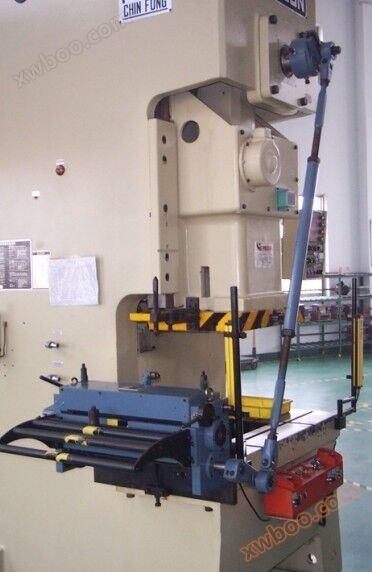
Local features:
1. Unidirectional bearings
Embedded with superhard alloy and matched with roller bearings, it has wear resistance, stability, high precision, and long service life.
The gear undergoes heat treatment with HRC60o and precision grinding, resulting in high transmission accuracy.
2. Roller
Adopting a hollow design, lightweight, and low rotational inertia, it can stop immediately to ensure feeding accuracy.
After heat treatment with HRC60o chrome plating and grinding, it has high hardness, excellent wear resistance, and long service life.
3. Disc brake (general brake device)
Adopting advanced clutch to ensure complete contact between the disc and rain surface, it has long service life, good stability, and high precision.
4. Reverse device
a. The structure, like a unidirectional device, can control the lower wheel quite accurately, and long-term use will not cause any backward movement of the lower wheel,
The stability and accuracy are quite high.
b. Do not cause the brake to fail due to residual oil splashing out during stamping, resulting in the phenomenon of the next wheel reversing and inaccurate delivery distance.
c. Not easy to generate high heat.
d. Equipped with superhard alloy and rollers, not easily worn.
e. The action mode is circular motion of the roller, rather than linear motion like four guide columns, so there will be no biting phenomenon.
f. The friction is small, the required transmission torque is relatively reduced, and the transmission mechanism is less likely to be damaged.
g. If equipped with a reverse device, the speed can reach 30 meters per minute, usually 20 meters per minute, which increases efficiency by 50%.
h. Structure increases the service life.
Note: The brake system is generally equipped as standard for each model. If there is a reverse device on the machine, the general braking device is for auxiliary use, that is, a dual braking system.
Advantages:
1. Suitable for continuous processing production.
2. High speed performance. (Up to 500 to 1000 times per minute)
3. Simple structure, economical and practical, low failure rate, and easy maintenance.
Feeding accuracy:
It varies depending on the number of revolutions and feeding length, with an accuracy of generally 0.05mm,
If the guide pin is used for positioning, an accuracy of ± 0.01mm can be obtained. |