
VIP member

Gatan in-situ heating table Murano 525
Brand: GATAN Name and Model: In situ Heating Stage Murano525 Distributor: Obotong Co., Ltd. Manufacturer: GATAN Company Product Overview: Product Func
Product details
Brand: GATAN Name Model: In situ heating table Murano 525
Distributor: Obotong Co., Ltd
Manufacturer: GATAN Corporation
Product Overview:
Product Function Introduction:
Heating samples in scanning electron microscopy has become an indispensable method in many materials science studies. The in-situ heating stage of scanning electron microscopy can be used to dynamically observe the microscopic changes and failure analysis of materials during temperature changes. Nowadays, it is widely used in many fields such as metal materials, liquid crystal detection, semiconductors, polymer materials, fluid inclusions, biotechnology, etc. The Murano 525 in-situ heating stage enables us to dynamically observe the phase transition, recrystallization, grain growth, and oxidation phenomena of the sample during the heating process.
Main technical features of the product:
The Murano heating table is compact and easy to interface with most standard sample tables for scanning electron microscopy. It includes an insulated interface suitable for secondary electron imaging, electron backscatter diffraction (EBSD), and focused ion beam (FIB) processing. Capable of quickly heating samples up to 9mm x 4.5mm x 1.5mm in size. This heating table can be conveniently used for the geometric configuration of EBSD while maintaining an appropriate working distance. The temperature range of the sample stage covers room temperature to 950 ℃. To carry out catalytic, reduction, or oxidation reactions, a capillary tube adjacent to the sample can be optionally equipped for gas injection. The external gas flow through the capillary tube is controlled by a needle valve on the flange. The water-cooled base ensures protection for SEM, the replaceable heat shield allows for routine imaging or EBSD analysis, and the software based temperature controller enables precise temperature control and recording. Integral bias can distinguish between secondary electrons and thermally emitted electrons, thereby improving imaging quality at high temperatures.

This figure shows the EBSD phase distribution of austenite to ferrite transition from 945 ° C to 880 ° C, with austenite appearing blue (dark) and ferrite appearing red (bright). A low carbon steel sample was used for testing, heated to 945 ° C, and then cooled at a rate of 1 ° C per minute until phase transformation was observed. Once the phase transition begins, keep warm to observe the process of phase change in individual grains, and then cool again. The data was provided by Dr. Singh Ubhi from Oxford Instruments.
Murano 525 in-situ heating table highlights technical advantages:
1. Capable of quickly heating and cooling samples up to several millimeters in size (>100 ° C/minute)
2. The compact size allows for the large angle tilt required for EBSD, facilitating the insertion and removal of the device
3. Research on Local Gas Reactions at High Temperatures
4. Temperature accuracy<± 0.5 ° C, stability<1 ° C/hour
5. Configure a water-cooling module to effectively protect the SEM compartment and safely achieve a sample temperature of 950 ° C
6. Customized for each SEM, easy to install/remove, and the SEM sample stage can be restored to its normal state within a few minutes
7. The new PC based temperature controller achieves precise control and can synchronize the surface distribution and temperature curve of EBSD
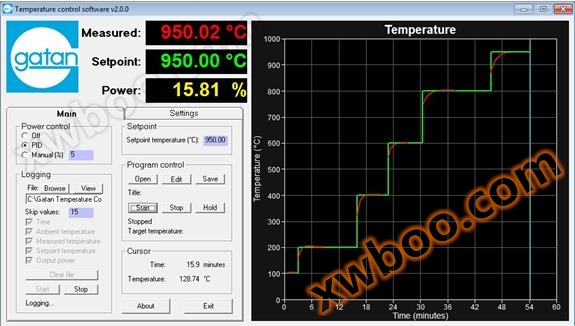
PC based temperature controller
Main technical parameters of the product:
1. Working distance: 10mm for shielded working distance, 12.5mm for unshielded working distance
2. Sample size: X 4.5mm, Y 9mm, Z (with shielding) 1.5mm, (without shielding) 3mm
3. Temperature stability: ± 0.5 ℃
4. Temperature control accuracy: ± 0.5 ℃
5. Temperature range: 950 ℃
6. Image Control System: DigiScanSEM Digital Electron Beam Control and Image Processing System
7. Protective measures: Equipped with a heat shielding device, it does not have a significant thermal impact on the objective lens and sample chamber, allowing for routine imaging or EBSD analysis
8. Structure: Compact and easy to install and remove, suitable for geometric configuration of EBSD while maintaining appropriate working distance
9. Temperature control: PID automatic control and manual control modes, can store all heating parameters, independent software control, can achieve synchronous EBSD surface distribution and temperature curve
Main application areas of the product:
EBSD in-situ analysis
Metallic materials
Petroleum Geology, Rock and Mineral Resources
Optoelectronic materials
Chemical polymer materials
New energy battery materials
semiconductor
Online inquiry
-
Contacts
-
Company
-
Telephone
-
Email
-
WeChat
-
Verification Code
-
Message Content
-