
VIP member

Converter dust collector
Scope of application: Pollution sources and characteristics of dust removal equipment for converter: The converter produces a large amount of flue gas
Product details
Converter dust removal equipmentPollution sources and characteristics of dust removal:
The converter produces a large amount of flue gas during the mixing of molten iron, the addition of scrap steel, and the pouring of steel. Some flue gas also escapes from between the skirt and the furnace mouth during the blowing process. When the converter is mixed with molten iron, almost half of the area in front of the furnace contains varying degrees of radiant heat generated by the molten iron, as well as emitted smoke and other harmful gases. The temperature of the pollution source is high, and the thermal radiation intensity reaches 4-15 cal/cm2. The workshop temperature is as high as 40-50 ℃, and the operating conditions are extremely harsh.
When the converter is mixed with molten iron, there is a large amount of smoke and dust, and the converter production has periodicity. Each converter produces steel 30-40 times a day. If the converter is not equipped withConverter dust removal equipmentDust removal measures not only pollute the environment and pose a threat to human health, but also hinder the normal operation of equipment and instruments.
Technical characteristics of dust removal system for converter dust removal equipment:
1. The total air volume of the dust removal system can be selected according to different smelting conditions, and there are pneumatic or electric high-temperature resistant butterfly valves near each suction port pipeline, which can be switched according to different smelting conditions;
2. The dust removal system adopts closed, humidified ash transportation and unloading to avoid secondary dust and pollution of the surrounding environment;
3. The flue gas temperature of the dust removal system in the casting yard is relatively high. A mixing valve is installed on the pipeline before entering the dust collector. When the flue gas temperature exceeds the set value, the mixing valve is opened to mix cold air into the system to ensure the safety of the dust collector bag;
4. To prevent bag compaction, if the pulse air source is compressed air, it needs to be dehydrated and heated;
5. The capture hood needs to be lined with an aluminum silicate insulation layer;
6. The dust removal system adopts PLC automatic control, and various operating parameters and statuses can be centrally displayed in the dust removal main control room. In order to facilitate system management, the main parameters of the dust removal system are measured and displayed, and necessary fault signals and signal alarms of the main equipment are displayed.
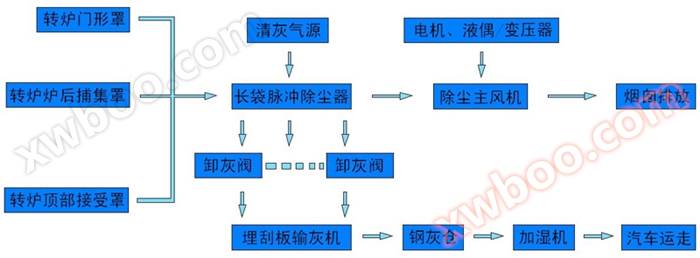
Flow Chart for Flue Gas Treatment of Converter Dust Removal Equipment
The capture form of smoke and dust in converter dust removal equipment:
The equipment in front of the converter mainly consists of a molten iron tank for mixing molten iron and a water-cooled furnace door, which are mobile devices that work frequently and cover a large space for movement. At present, the majority of flue gas capture methods for secondary dust removal systems in domestic converters are front door shaped exhaust hoods. The surrounding areas of the converter above the operating layer are completely enclosed. In order to effectively capture the flue gas generated during steelmaking, a smoke baffle is placed under the operating platform to allow the flue gas to rise into the enclosed room, and a smoke hood is installed behind the furnace. The front door shaped exhaust hood of the converter can only capture the flue gas during the mixing of molten iron and scrap steel in the converter; The smoke hood behind the furnace can capture the smoke generated during the tilting and tapping process; However, none of them can fully capture the smoke and dust escaping from the skirt and mouth of the converter during smelting. Therefore, it is necessary to receive a cover at the top of the converter to fully capture the smoke and dust generated during smelting.
Online inquiry
-
Contacts
-
Company
-
Telephone
-
Email
-
WeChat
-
Verification Code
-
Message Content
-