
VIP member

Ceramic deep groove ball bearing 693CE
Comparison of the performance of four bearing materials: ordinary bearing steel AISI52100 (GCr15), stainless steel AISI440 (9Cr18), silicon nitride (S
Product details
The performance comparison of four bearing materials, including ordinary bearing steel AISI52100 (GCr15), stainless steel AISI440 (9Cr18), silicon nitride (Si3N4), and zirconia (ZrO2), shows that ceramic bearings, as an important mechanical foundation component, have excellent properties that metal bearings cannot match, such as high temperature resistance and super strength, leading the way in the world of new materials. In the past decade, it has been increasingly widely applied in various fields of national economy and people's livelihood. The first advantage is that ceramics are almost not afraid of corrosion, so ceramic rolling bearings are suitable for operation under harsh conditions filled with corrosive media. Secondly, due to the lower density and lighter weight of ceramic rolling balls compared to steel, the centrifugal effect on the outer ring during rotation can be reduced by 40%, thereby greatly extending their service life. Thirdly, ceramics are less affected by thermal expansion and contraction than steel, so when the clearance between bearings is constant, they can allow bearings to work in environments with significant temperature differences. Fourthly, due to the higher elastic modulus of ceramics compared to steel, they are less prone to deformation under stress, which is beneficial for improving working speed and achieving higher accuracy.
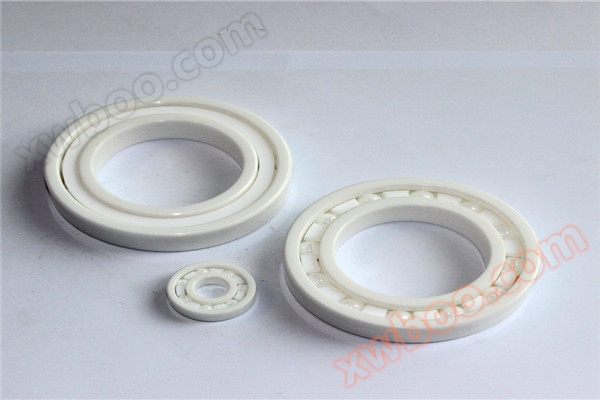
The main applications of ceramic bearings include high temperature resistance, cold resistance, wear resistance, corrosion resistance, resistance to magnetic and electrical insulation, oil-free self-lubricating, and high speed. It can be used in extremely harsh environments and special working conditions, and can be widely applied in aviation, aerospace, navigation, petroleum, chemical, automotive, electronic equipment, metallurgy, power, textiles, pumps, medical equipment, scientific research, and national defense and military fields. It is a high-tech product for the application of new materials. The rings and rolling elements of ceramic bearings are made of all ceramic materials, including zirconia (ZrO2), silicon nitride (Si3N4), and silicon carbide (Sic). The retainer is made of polytetrafluoroethylene, nylon 66, polyetherimide, zirconia, silicon nitride, stainless steel or special aviation aluminum, thereby expanding the application range of ceramic bearings. Application areas include medical devices, low-temperature engineering, optical instruments, high-speed machine tools, high-speed motors, printing machinery, and food processing machinery. In fields such as aerospace, navigation, nuclear industry, petroleum, chemical, textile industry, machinery, metallurgy, power, food, locomotives, subways, high-speed machine tools, and scientific research, defense, and military technology, it is necessary to work under special working conditions such as high temperature, high speed, deep cold, flammable, explosive, strong corrosion, vacuum, electric insulation, non-magnetic, and dry friction. The indispensable substitute role of ceramic bearings is gradually being recognized by people. With the continuous advancement of processing technology and the increasing level of craftsmanship, the cost of ceramic bearings has been continuously decreasing. They have gradually been promoted from being applied only in a small range of high, precision, and cutting-edge fields in the past to various industrial fields in the national economy. The market price of products is also gradually approaching practicality, reaching a level that users can accept. The wave of large-scale application of ceramic bearings has surged!
Online inquiry
-
Contacts
-
Company
-
Telephone
-
Email
-
WeChat
-
Verification Code
-
Message Content
-