
VIP member
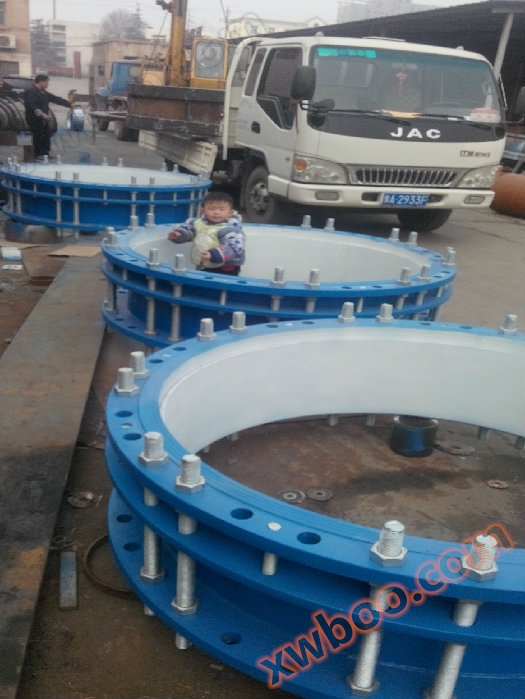
C2F double flange loose sleeve transmission joint
Loose sleeve transmission joint is composed of flange loose sleeve expansion joint, short pipe flange, transmission screw and other components, which
Product details
Loose sleeve transmission joint is composed of flange loose sleeve expansion joint, short pipe flange, transmission screw and other components, which can reduce the pressure thrust (blind plate force) of the connected parts and compensate for pipeline installation errors. Double flange transmission joint cannot absorb axial displacement. Double flange force transmission joints are mainly used for loose connections of accessories such as pumps and valves.
The main materials for each part are:
Number No |
Name |
Quantity Quantity |
Material Material |
1 |
ontology |
1 |
QT450-10,Q235A |
2 |
sealing ring |
1 |
NBR |
3 |
cover pressing |
1 |
QT450-10,Q235A |
4 |
Limit short tube |
1 |
Q235A |
5 |
bolt |
n |
Q235A,35# |
6 |
nut |
Tn |
Q235A,20# |
[Scope of Application] This product is suitable for transporting media such as seawater, fresh water, hot and cold water, drinking water, domestic sewage, crude oil, fuel oil, lubricating oil, finished oil, air, gas, steam and granular powder with a temperature not exceeding 250 degrees Celsius.
【 Common models 】 VSSJAFG (CF) type single flange loose sleeve transmission joint, VSSJAF (C2F) type double flange loose sleeve transmission joint, VSSJAFC (CC2F) type detachable double flange loose sleeve transmission joint
【 Installation Instructions 】
A. First, loosen the nut on the middle cover to make the sealing ring almost unusable. Then adjust the short pipe to the optimal size of 1/2 Δ L. Adjust the joint and remove the first nut of the stud to make the pipe pass through the center. Align the head of the stud with the flange hole of the pipe, and then proceed with one end installation.
B. The nut pressure should be symmetrical and gradually tightened.
C. Install the other end flange, and so on.
D. Symmetrically gradually tighten the gland nut to adapt.
E. When working, if it is found that the local sealing is not tight, the gland nut can be tightened locally to prevent leakage. If the sealing at both ends is not tight, gradually tighten the nuts at both ends of the flange until there is no leakage.
Online inquiry
-
Contacts
-
Company
-
Telephone
-
Email
-
WeChat
-
Verification Code
-
Message Content
-