VIP member
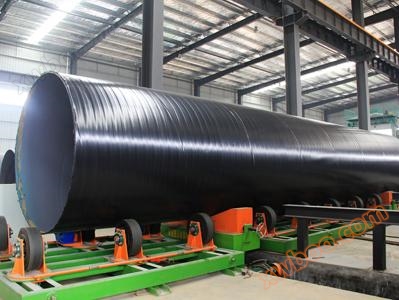
3PE anti-corrosion spiral steel pipe
The anti-corrosion layer of the steel pipe consists of three layers: the first layer is epoxy powder (FBE ≥ 120um), the second layer is adhesive (AD ≥
Product details
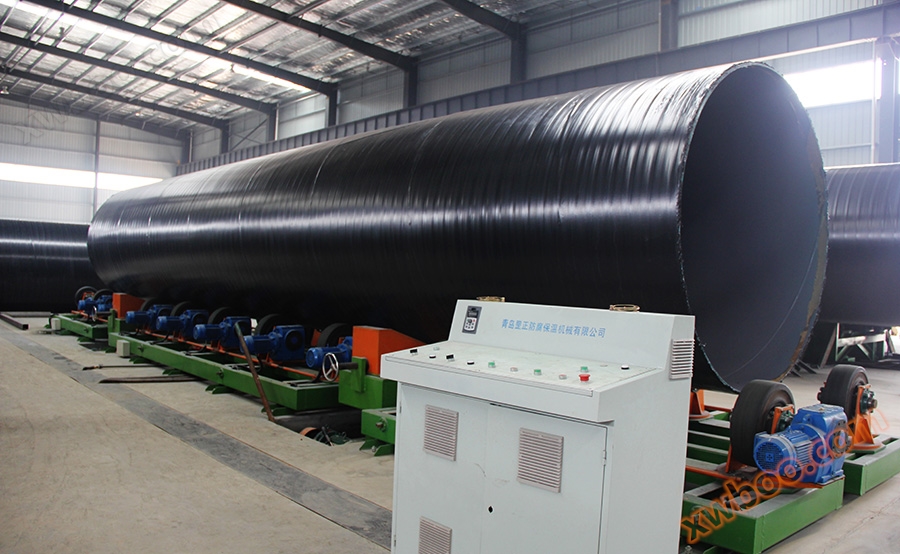
The anti-corrosion layer of the steel pipe consists of three layers: the first layer is epoxy powder (FBE ≥ 120um), the second layer is adhesive (AD ≥ 170um), and the third layer is polyethylene (PE ≥ 2.5-3.7mm). The three layers of materials are integrated and firmly bonded with the steel pipe to form an excellent anti-corrosion layer. The 3PE epoxy powder anti-corrosion coating has strong corrosion resistance, simple and convenient construction, and a service life of up to 50 years. It also has good corrosion and impact resistance under low temperature conditions, as well as high epoxy strength, low water absorption of PE, and good flexibility of hot melt adhesive, making it highly reliable for corrosion prevention.
Application field
3PE anti-corrosion spiral steel pipe is mainly used in sewage treatment, water engineering, petrochemical industry, chemical industry, power industry, river treatment, agricultural irrigation, bridge infrastructure construction, urban construction, and is one of the twenty key products developed in China.
-
-
Coal mine: underground water supply and drainage, underground spray racks, positive and negative pressure ventilation, gas drainage, fire sprinkler and other pipe networks.
Power plant: Process water waste residue and return water transportation pipeline for thermal power plants.
Firefighting: Water supply pipelines for sprinkler and sprinkler systems.
Highways: Electrical, communication, highway and other electrical grade protective sleeves.
Municipal engineering: high-rise building water supply, heating network, water supply engineering, gas transmission, buried water transmission pipelines, etc.
Petroleum: Process pipelines used for transporting corrosive media in industries such as petroleum transportation pipelines, chemical pharmaceuticals, and printing and dyeing.
Sewage treatment: Sewage treatment discharge pipes, sewage pipes, and biological tank anti-corrosion engineering.
Agriculture: Network of agricultural irrigation pipes, deep well pipes, drainage pipes, etc.
production process
-
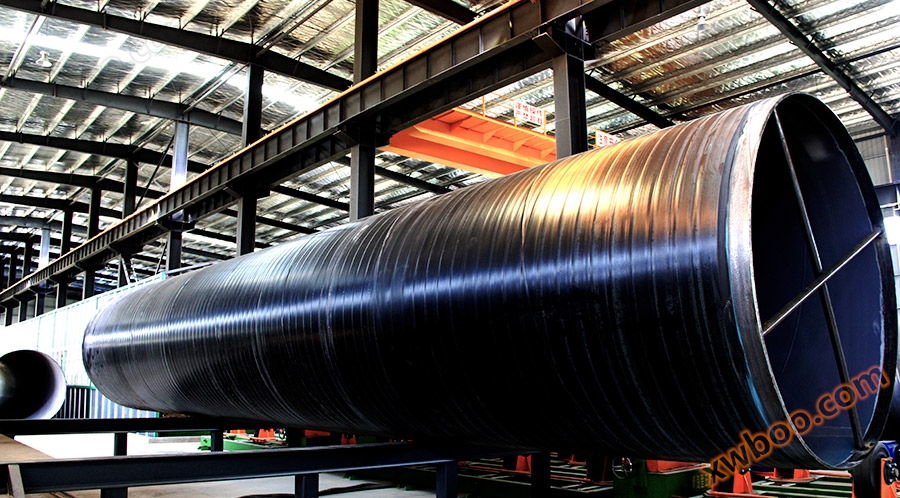
Internal anti-corrosion production process
High speed steel sand and quartz sand beams are used to remove rust and clean the inner wall of steel pipes using hydraulic and electric polishing heads, as well as pneumatic sandblasting guns. Sandblasting is used for diameters less than 700mm, and shot blasting is used for diameters greater than 700mm. The rust removal efficiency can reach 80-150 ㎡/h, and the rust removal effect can reach 0.5-3 levels.
The high-speed nozzle using high-pressure airless spraying is used to evenly spray anti-corrosion coatings of various powders, liquids, and other materials onto the inner wall of the steel pipe, achieving the purpose of anti-corrosion, drag reduction, and prolonging the service life of the steel pipe.
-
External anti-corrosion production process
Process flow diagram of three-layer PE anti-corrosion steel pipe
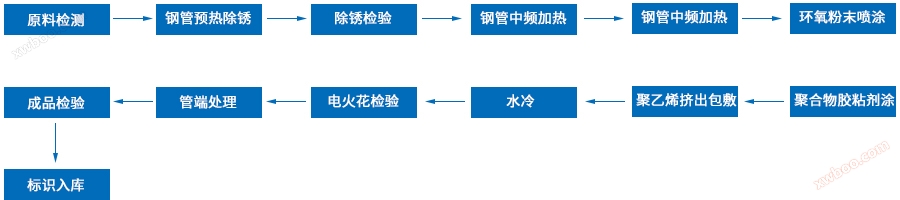
Process flowchart of two-layer PE anti-corrosion technology

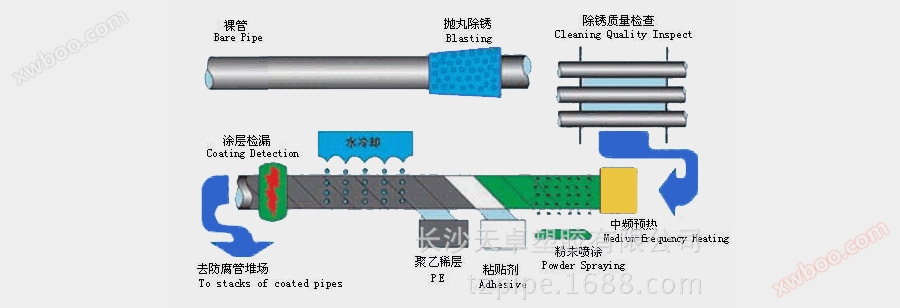
-
Raw Material Inspection
Steel pipes should comply with national or relevant industry standards: seamless steel pipes with a nominal diameter ≤ DN150 and a diameter of 20 # should be used; Spiral steel pipes with nominal diameter ≥ DN200 shall be made of Q235 or other materials. Steel pipe execution standard:
① GB/T9711-2011 Steel pipes for pipeline transportation systems in the petroleum and natural gas industry (replacing GB/T9711.1-1996, GB/T9711.2-1999, GB/T9711.3-2005).
② SY/T5037-2012 Submerged Arc Steel Pipe for Ordinary Liquid Transport (Petroleum and Natural Gas Industry Standard, replacing SY/T5037-2000).
③ GB/T8163-2008 Seamless steel pipes for conveying fluids (replacing GB/T8163-1999)
-
shot blasting
Rust removal on the surface of steel pipes is the foundation of anti-corrosion, and the quality of rust removal directly affects the subsequent anti-corrosion quality. Before shot blasting and rust removal of steel pipes, a medium frequency induction heater should be used to preheat the pipes. The preheating temperature should reach the requirement of 40 ℃ -60 ℃ to eliminate all moisture and surface dirt;
Rust removal level (1) Dust treatment: After shot blasting rust removal treatment on the surface of the steel pipe, clean and dry compressed air should be used to blow away the dust that has already adhered to the surface of the steel pipe to prevent moisture, rust or secondary pollution. The surface should be coated with epoxy powder anti-corrosion layer within 4 hours. (2) The rust removal grade of the outer wall of the steel pipe should meet the requirement of Sa2.5 (near white grade). (3) The anchor depth should meet the specified requirement of 50 μ m-90 μ m.
-
Intermediate frequency heating of steel pipes
Before spraying epoxy powder, use a medium frequency induction heater to heat the tube to 190-230 ℃.
-
Epoxy powder spraying
After induction heating, the steel pipe rotates in a spiral and enters the spraying room. The epoxy powder is evenly sprayed onto the surface of the steel pipe using the high-voltage electrostatic multi nozzle spraying method, with a thickness of ≥ 120 μ m; Powder forms a film at high temperature and firmly adheres to the surface of the steel pipe and the substrate.
Curing of epoxy powder anti-corrosion coating: Epoxy powder generally gelatinizes within 30 seconds and solidifies within 1.5 minutes. By controlling the distance between spraying and cooling, the curing time is ensured, and a smooth, dense, and firm coating is formed after curing. The cured anti-corrosion layer has excellent anti-corrosion performance, good chemical corrosion resistance, a dense and smooth coating surface, wear resistance, and high temperature resistance.
-
Apply adhesive
Before the epoxy powder is gelatinized, wrap the viscous adhesive laterally around the powder layer to fuse with it, and the thickness of the adhesive layer should be ≥ 120 μ m.
During the process of drilling holes by pulling back the drill rod, it is necessary to inject bentonite slurry through the drill rod to reduce friction, lower rotational torque and pullback resistance. At the same time, bentonite slurry also has the functions of wall stabilization, preventing hole collapse, and cooling the drill bit. The soil cut by the rotating expansion head is mixed with bentonite slurry to form a slurry, which flows into the slurry collection pit of the outlet working pit, achieving the purpose of discharging the soil. A mud pump is installed in the mud pit to pump mud into the mud pit.
-
Extruded polyethylene
The extrusion temperature of polyethylene is 230-260 ℃. The extruded viscous polyethylene is wrapped laterally onto the adhesive layer on the surface of the suspended pipeline using the waterfall rotational molding method; And use roller pressing to firmly bond it with the adhesive layer. The adhesive is fused with epoxy powder and bonded to the polyethylene layer, and the three-layer structure aggregates with each other to form a smooth, bubble free, pockmarked, wrinkle free, and defect free whole.
-
Coating tube cooling
According to the characteristics of the three-layer structural material, the anti-corrosion layer is cooled by circulating water spray cooling. After cooling, the surface temperature of the anti-corrosion layer should not exceed 30 ℃.
-
Coating leak detection
During the production process, an online electric spark leak detector is used to perform pinhole inspections (100% leak detection) one by one, with a leak detection voltage of 25KV. The anti-corrosion pipe is considered qualified if there are no leaks, and any leaks are marked in a timely manner for post production repair.
-
Pipe end processing
The coated pipe end needs to be polished for welding. Use a bevel polishing machine to polish the pipe end, polishing only the 120-250mm welding retention section.
-
Finished Product Inspection
1. Appearance inspection 2. Thickness inspection of anti-corrosion layer 3. Performance inspection of anti-corrosion layer
Online inquiry
-
Contacts
-
Company
-
Telephone
-
Email
-
WeChat
-
Verification Code
-
Message Content
-